This short film made with Seedance 2.0 is absolutely insane.The realism looks like a real movie — no one can…
-
The subprime crisis at UCLA
I’m happy with the way things worked out yesterday, March 8th, at the UCLA Complexity Science Conference with my paper: The Subprime Crisis: A Human Complex Systems Phenomenon.
Of course, trying to squeeze the whole crisis into an hour (1 ¼ with John Bragin’s express permission), it turned out I had much too much material. I don’t think personally that slide shows have enough meat to show that they can get circulated without their author fleshing them up. This is why I’m not communicating as of yet what I had to say but I’ll be working in the coming…
-
Pricing models: why the good ones are useless and the true ones, priceless
I’ve mentioned already in Agents using financial models and the “human cognitive cocktail” a number of pitfalls linked to the task of modeling the subprime crisis in a Human Complex Systems perspective, especially those related to agents’ partial understanding of the models they’re using or in errors they’re making when using them. I’ve also hinted at some models making unwarranted claims about their ability at forecasting. I should also mention – as I was recently reminded – inflated assumptions about the virtues of diversification or, I should rather say, at the capacity of the markets to remain optimally…
-
Agents using financial models and the “human cognitive cocktail”
I’m working on the paper to be given at the Human Complex Systems’ one-day conference on March 8th. I don’t want to divulge prematurely any scoop but at the same time I’d like to share some of my puzzlement as I go, and as if thinking aloud.
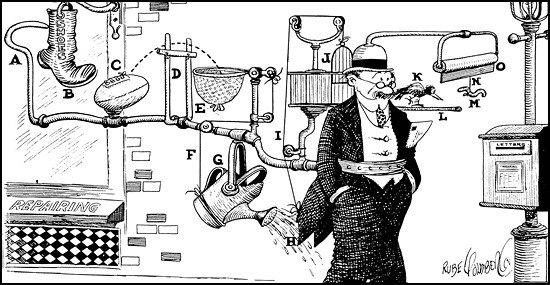
To recap: I’m toying with the concept of a large – as complex as need be – model of the subprime crisis. The easy parts are those which are already modeled of that Rube Goldberg machine (see diagram), like the cash flow…
-
The subprime crisis: a human complex system phenomenon
I’ll be speaking at UCLA on Saturday March 8th, 2008 at the
Human Complex Systems – UCLA Four Campus Complexity Conference,
UCLA Haines Hall 352. The conference starts at 9 AM, my own talk is at 2:30 PM.If it looks like proposing an entirely new paradigm for financial studies, that’s because that’s precisely what it is. Hope you can join!
The subprime crisis: a human complex system phenomenon
Explanations of the subprime crisis typically combine partial explanations, illustrations, “speaking” analogies, etc. treading at different levels: from the “elementary particle” level where the consumer and the financial…
-
The subprime crisis in 2007
I’m aware I’ve neglected my English blog but there were two good justifications for that: I was finishing writing up a new book called “La crise des subprimes en 2007” (untranslatable) and I was promoting that coming book in Paris by speaking at the Ecole Normale Supérieure, talking on the radio and giving several interviews to dailies and weeklies.
My book that was published just a year ago, “Vers la crise du capitalisme américain?” made it to the top ten list of the (French) “Readers of economy books’ prize” – which was a nice surprise…
-
2008’s new fad: “rating cliffs” and “credit cliffs”
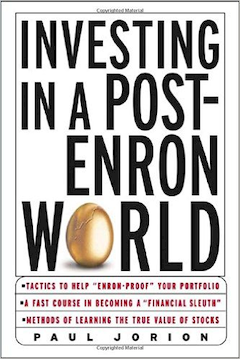
Do you know what will be all the rage in 2008 in the wake of the subprime crisis? “Rating cliffs” and “credit cliffs” when firms that have seen a slow erosion of their credit will all of a sudden drop like a stone. As I devoted a whole chapter to the subject back in 2003 when drawing some lessons from Enron’s demise, I decided to revive it for your enlightenment. Here it is from
Paul Jorion, Investing in a Post-Enron World, McGraw-Hill, 2003.
Enjoy!“Chapter 13: The perils of cliffs
Once upon a time, a company named Enron…
-
The individual unit in the network as far as speech generation is concerned is a word-pair
Thought as word dynamics. II. Architecture (5)
Mathematically speaking, a graph is a set of ordered pairs. It can be decomposed in elementary units of individual pairs. Each of the two elements in an ordered pair represents a node in the graph and every pair represents an edge. Say, there are four nodes, A, B, C and D and the graph is defined as (a, b), (b, c), (c, d) and (a, c), the corresponding graph is as represented in the figure below.
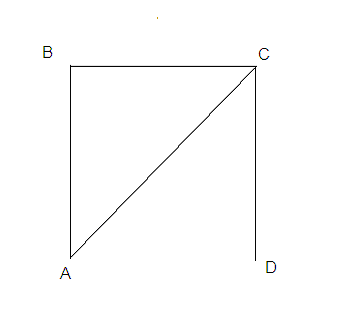
An example of a word-pair is “cat-feline” and each…
-
The long-term goals of businesses
Businesses don’t seem to have any long–term goals apart from staying in business. They no doubt provide benefits to their shareholders and executives during their lifetime but why they aim at persisting in their existence with little reflection devoted to the “why?” of it is far from obvious. There is a clear analogy here with people and groups of people who – as we know from experience – persist in their endeavors without often much of a justification for why.
An analogy can be drawn here with a particular form of kinship structure which the anthropologist Marshall Sahlins explained in…
-
Human Complex Systems
My French blog was started on February 28th, my English blog, a few days later, on March 3rd, both of this year. By mid-July, the French blog had an average readership of 40 per day, among whom about 20 new readers; by now, 4 months later, the average readership is 160 (over the past 30 days), among whom about 100 new readers per day. The English blog, from its inception has had a following of anywhere between 0 and 30 a day.
The reason for the different fates of the two blogs is clear: the average time between two posts…
-
Gold fish
I just had an odd vision. It happens on Judgment Day and I am shocked at the questions being asked from me: “How many gold fish in your care died of neglect? How many babies did you leave crying in the dark? Who were they? How many daisies did you trample?” I say “I feel very unprepared for such questions, I had concentrated on – you know – the broader issues, like honesty or being courageous…” And the official presses on “How many daisies? Come on! give me a figure! Two thousands? Five thousands?”
Contact
Contact Paul JorionMost recent comments
In the age of AI, the danger is not knowing less than machines, but understanding too slowly the structure of…
Ouch! The whole of cosmology was standing on its head, and now it’s back on its feet! And everything becomes…
To expand on this reflection, I’d like to propose an image that radically inverts our usual representation of the Big…
[…] GENESIS is a machine predicting where emergence will occur and what form it will take: the form that minimises descriptive length and maximises cross?representational coherence.…
[…] 2. Pribor’s Combinatorial Magic […]
[…] that’s left to do is get on with it ? So I followed DeepSeek’s advice, as I let you…
Well! It is comments such as yours that make the trip … worthy of the trouble! 😀
When I saw your work on P vs NP, I knew you were on to something profound. I couldn’t have…
Admittedly, I was a little thrown off by the direction this took. From my perspective, you (1) identified the major…
Most recent posts
- For Geeks only: A Day in the Life…
- Why I wrote Rethinking Intelligence in the Age of Artificial Minds – A Plea for a Human–AI Covenant
- Understanding Faster Beats Knowing More in AI Age – Paul Jorion
- AIs and humans: a question of future mutual benevolence
- PRIBOR – GENESIS: A Mathematical Framework for Predicting Emergence
My books

















Topics
- "Rethinking Intelligence in the Age of Artificial Minds"
- "Who Were We?"
- A NEW "US" FOR NEW TIMES
- Anthropology
- Art
- Artificial Intelligence
- Blog
- Brexit
- China
- Computing
- consciousness
- Cross-Flow Resonance Theory
- Cross?Flow Resonance Theory
- Currency
- Democracy
- Ecology
- Economy
- Essential questions
- Europe
- Extinction threat
- Finance
- Fine arts
- Fiscality
- Fukushima
- Fun
- GENESIS
- History
- Human complex systems
- Internet
- Labour
- Law
- Libor
- Literature
- LLM
- Logic
- Mathematics
- Mystery
- neuroscience
- Nonsense
- Pandemic
- Philosophy of science
- Physics
- Politics
- PROTEST MOVEMENTS
- Psychoanalysis
- Scotland
- Sociology
- Spain
- Stewardship of Finance
- Subprime
- The Singularity
- Transhumanism
- United Kingdom
- United States
- Unspecified
- War
Tags
"L'avènement de la Singularité" "Thought as Word Dynamics" ANELLA A NEW "US" FOR NEW TIMES Angela Merkel Aristotle Artificial Intelligence Barclays Brexit capitalism CFRT Chair "Stewardship of Finance" China Claude 3 consciousness debt Donald Trump ECB EFSF emergence ESM Europe eurozone France GENESIS Germany GPT-4 Greece Herman Van Rompuy IMF Italy Jean-Claude Juncker José Manuel Barroso Large Language Models LIBOR linguistics LLM Mario Draghi Pribor.io Psychoanalysis P vs NP Spain speculation The Singularity United States